Table of Contents
ToggleDallas’s climate isn’t kind to commercial HVAC systems. Summer highs routinely push past 100°F, while winter cold snaps can drop below freezing overnight. Commercial units run longer, work harder, and break down faster than systems in milder regions. Regular maintenance isn’t optional, it’s the difference between a system that lasts 15 years and one that fails at 8, leaving tenants sweating and property owners facing five-figure replacement bills. This guide covers what property owners and facility managers need to know about keeping commercial HVAC systems running efficiently in Dallas’s punishing climate.
Key Takeaways
- Commercial HVAC maintenance in Dallas is essential to prevent system failures and extend equipment lifespan from 8 years to 12-15 years, avoiding costly replacement bills of $6,000-$12,000+ per ton.
- Neglected commercial HVAC systems lose 15-30% efficiency within a single season due to dirty filters, clogged condenser coils, and refrigerant issues, directly increasing energy costs.
- Quarterly maintenance visits with licensed HVAC contractors, including pre-season tune-ups in March and monthly filter replacements, are the industry standard for commercial buildings in Dallas’s extreme climate.
- Dallas’s cottonwood seeds and 100+ days annually above 90°F create unique maintenance challenges that require condenser coil cleaning, proper refrigerant pressures, and preventive maintenance agreements to avoid emergency service calls.
- A well-maintained commercial HVAC system saves 10-20% on annual energy costs, which can total $2,000-$5,000 for larger buildings, making preventive maintenance investments financially worthwhile.
- Poor HVAC maintenance creates liability risks through reduced indoor air quality and mold growth, potentially triggering tenant complaints and legal issues in Texas commercial properties.
Why Commercial HVAC Maintenance Matters in Dallas’s Extreme Climate
Dallas experiences roughly 100 days per year with temperatures above 90°F. Commercial rooftop units (RTUs) and split systems bake in direct sun while pulling superheated air across condenser coils. Without consistent maintenance, refrigerant pressures spike, compressors overheat, and evaporator coils ice over.
Commercial systems differ from residential units in critical ways. They’re modular, often ranging from 3 to 25 tons per unit, and many buildings run multiple units zoned by floor or tenant space. A single failed unit can render entire sections of a building unusable, triggering lease violations or lost revenue.
Neglected systems lose efficiency fast. Dirty filters restrict airflow, forcing blower motors to work harder and draw more amperage. Condenser coils caked with cottonwood seeds (a notorious Dallas springtime issue) can’t reject heat effectively, causing the system to short-cycle and wear out contactors and capacitors. Energy costs climb 15-30% when maintenance lapses for even a single season.
There’s also a liability component. Poor indoor air quality from clogged filters or mold growth in drain pans can trigger complaints or health issues among tenants. In Texas, commercial property owners have a duty to maintain habitable conditions, and HVAC failure in July can escalate quickly into a legal problem.
Maintenance extends equipment life, plain and simple. A well-maintained commercial unit in Dallas should reach 12-15 years, while neglected systems often fail before year 10. Replacement costs for a commercial RTU start around $6,000-$12,000 per ton, not including crane rental, electrical upgrades, or structural reinforcement if the roof decking has deteriorated.
Essential Commercial HVAC Maintenance Tasks for Dallas Buildings
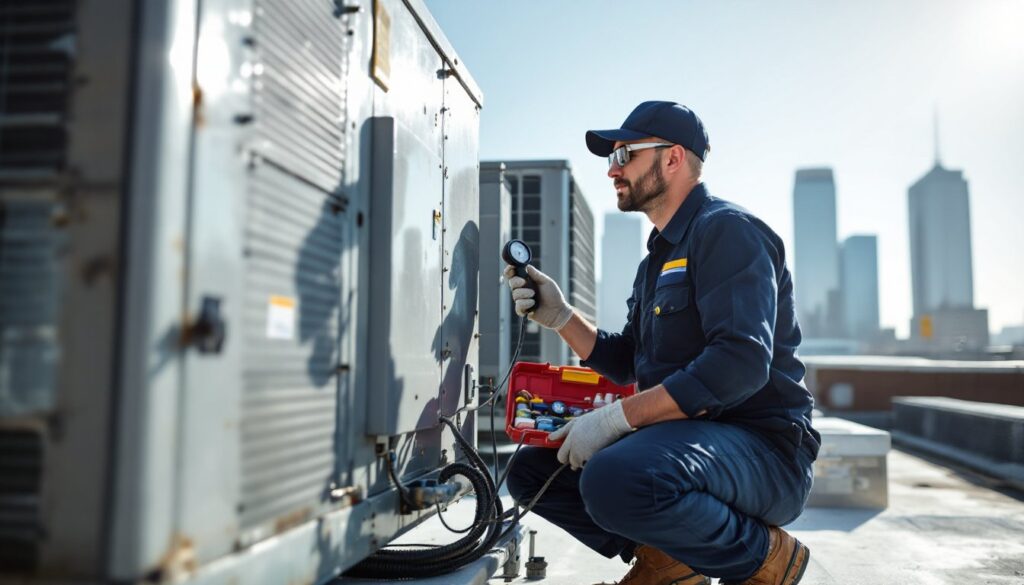
Commercial HVAC maintenance breaks into tasks the property owner can handle in-house and those requiring a licensed technician. Here’s what needs to happen regularly:
Monthly tasks (in-house or via contracted janitorial):
- Replace or clean air filters. Commercial systems use pleated filters rated MERV 8-13. A 20×25×4 filter in a busy office building may need monthly replacement during cooling season.
- Check condensate drain lines. Dallas humidity during summer means heavy condensate flow. Algae growth clogs drain lines, causing overflow and ceiling damage. Pour a cup of diluted bleach (1:10 ratio) down the drain pan monthly.
- Inspect thermostats and controls. Verify setpoints haven’t drifted and programmable schedules match occupancy. A thermostat stuck in “on” instead of “auto” wastes energy.
Quarterly tasks (licensed HVAC technician):
- Inspect and clean condenser coils. Use coil cleaner and a low-pressure rinse. Never use a pressure washer, it bends fins.
- Check refrigerant charge and pressures. Low refrigerant indicates a leak: overcharge kills compressor efficiency.
- Test capacitors and contactors. Capacitors weaken over time. A failing start capacitor causes hard starts and compressor damage.
- Lubricate blower motors and bearings (if not sealed units).
- Inspect ductwork for leaks. Flex duct connections and poorly sealed plenums lose 20-30% of conditioned air in unconditioned attic or ceiling spaces.
Annual tasks (pre-season tune-up):
- Full electrical inspection. Tighten connections, check amp draw on compressor and blower, test safety controls.
- Inspect belts and pulleys. Replace cracked or glazed belts. Check alignment.
- Clean and inspect burners and heat exchangers (gas heating units). Cracked heat exchangers leak carbon monoxide, safety critical.
- Test economizer operation (if equipped). Economizers use outside air for free cooling but fail when damper actuators seize.
- Calibrate controls and verify zone dampers (for multi-zone systems).
Seasonal Maintenance Considerations
Dallas has two HVAC seasons: cooling (April through October) and a brief heating season (December through February). Shoulder months see wild temperature swings, 80°F at 3 PM, 50°F by sunrise.
Pre-cooling season (March): This is the critical service window. Schedule tune-ups before the first heat wave hits. Technicians are less busy, and you’ll catch problems before a 105°F day takes the system down. Property managers should plan for this visit to include refrigerant checks, coil cleaning, and electrical testing.
Pre-heating season (November): Less critical in Dallas, but gas furnaces and heat pumps still need inspection. Test igniters, check for proper flame color (blue, not yellow), and verify carbon monoxide detectors are functional.
During peak cooling (July-August): If the system hasn’t been maintained, this is when it fails. Keep an emergency HVAC contact ready. Expect 48-72 hour lead times for service calls during heat waves, techs are slammed.
Cottonwood season (late April through May) deserves special mention. The fluffy seeds clog condenser coils and intake grilles. Some property managers hose off condenser coils weekly during cottonwood peak or install mesh screens (though screens require their own cleaning to avoid restricting airflow).
How Often Should You Schedule Commercial HVAC Maintenance?
Industry standard for commercial systems is quarterly maintenance visits, but Dallas’s climate and your building’s use case may require more.
Quarterly (minimum): Works for low-occupancy buildings like small warehouses or owner-occupied offices with light use. Technician visits align with seasonal transitions and catch most issues before they escalate.
Monthly: Recommended for high-occupancy buildings, retail centers, restaurants, medical offices, or any tenant space with dense foot traffic. Higher occupancy means more particulate load on filters, more wear on blower motors, and greater risk if the system fails.
Bi-weekly filter changes: Necessary in environments with heavy dust (construction nearby, unpaved lots) or in buildings with sensitive tenants (medical facilities, daycare centers).
Commercial property owners should also budget for emergency service calls. Even with perfect maintenance, components fail. A compressor capacitor costs $150-$300 to replace but requires a service call. Some property managers keep common parts on-site (capacitors, contactors, filters) and have a handyman trained to swap them, though electrical work on HVAC systems requires a licensed technician in most Texas jurisdictions.
Don’t skip the pre-season tune-up. It’s the most important visit of the year. Skipping spring maintenance to save $300 often leads to a $3,000 compressor replacement in July.
Choosing the Right Commercial HVAC Maintenance Provider in Dallas
Not all HVAC contractors handle commercial work, and not all commercial contractors are equally competent. Here’s what to verify:
Licensing and insurance: Texas requires HVAC contractors to hold a TACL license (Texas Air Conditioning Contractors License). Verify the license is current at https://www.tdlr.texas.gov. Contractors should carry general liability and workers’ comp insurance, ask for certificates.
Commercial experience: Residential HVAC techs often lack the training for commercial refrigeration systems, modular RTUs, or building automation systems (BAS). Ask how many commercial properties they service and request references from similar building types.
Service agreements vs. per-call billing: Most commercial contractors offer preventive maintenance agreements (PMAs). You pay a flat annual or quarterly fee, and they schedule regular visits. PMAs typically include priority scheduling and discounted labor rates for repairs. Compare PMA costs to per-call rates, if you’re scheduling quarterly visits anyway, the PMA usually saves money.
Response time guarantees: Ask about emergency response windows. Some contractors guarantee same-day or next-day emergency service for PMA customers. In July, that matters.
References and reviews: Platforms listing top-rated Dallas HVAC professionals can help identify contractors with strong track records. Look for consistent reviews mentioning commercial work, not just residential service.
Documentation and reporting: Good contractors provide written service reports after each visit, noting pressures, amp draw, parts replaced, and recommendations. This documentation is critical for warranty claims and helps track system performance over time.
Cost Considerations for Commercial HVAC Maintenance in Dallas
Costs vary by building size, equipment type, and service frequency, but here are Dallas-area ballpark numbers as of 2026:
Preventive maintenance agreements: Expect $150-$400 per unit per visit for a standard rooftop unit (3-10 tons). Quarterly service for a small office building with two 5-ton units runs roughly $1,200-$3,200 annually. Larger buildings with 10+ units or complex systems (chillers, VRF systems) pay significantly more.
Emergency service calls: After-hours or weekend calls often carry $150-$250 trip charges plus hourly labor ($100-$150/hour). Parts are extra.
Common repair costs (parts + labor):
- Capacitor replacement: $150-$300
- Contactor replacement: $150-$350
- Thermostat replacement: $200-$600 (depends on type, simple digital vs. networked smart thermostat)
- Refrigerant recharge (plus leak repair): $500-$1,500
- Blower motor replacement: $600-$1,200
- Compressor replacement: $2,000-$5,000+ (often makes more sense to replace the entire unit)
Energy savings from regular maintenance offset some costs. A well-maintained system uses 10-20% less energy than a neglected one. For a 50,000-square-foot building, that can mean $2,000-$5,000 in annual savings on electricity.
Property owners should also factor in downtime costs. A failed HVAC system in a retail space or restaurant can mean lost revenue, potentially thousands per day. Budgeting for proactive maintenance is cheaper than emergency repairs and lost business. Resources like project cost estimators can help property managers budget for HVAC expenses alongside other building maintenance.
Conclusion
Commercial HVAC maintenance in Dallas isn’t optional, it’s survival. The climate is too extreme, the equipment too expensive, and the stakes too high to skip regular service. Quarterly maintenance visits, pre-season tune-ups, and monthly filter changes keep systems running efficiently and prevent catastrophic failures during peak cooling season. Invest in a solid preventive maintenance agreement with a licensed commercial contractor, and budget for it like you would property insurance. The alternative is hotter, more expensive, and usually happens in July. For more seasonal maintenance checklists, property owners can find additional guidance on keeping commercial buildings running smoothly year-round.