Table of Contents
ToggleIf you own or manage a commercial building, you already know the HVAC system isn’t something you can ignore until it breaks. A dead rooftop unit in July or a failed boiler in January doesn’t just inconvenience tenants, it can shut down operations, trigger emergency repair bills that run into five figures, and trash your property’s reputation. That’s where a commercial HVAC maintenance agreement comes in. These contracts aren’t just about changing filters twice a year. They’re structured service plans that keep large-scale heating and cooling systems running efficiently, catch problems before they cascade, and give you predictable costs instead of surprise invoices.
Key Takeaways
- A commercial HVAC maintenance agreement is a structured service contract that provides scheduled inspections, preventive maintenance, and predictable costs while preventing costly emergency repairs and unexpected downtime.
- Regular maintenance catches problems early—such as refrigerant leaks and failing capacitors—avoiding catastrophic failures like a $12,000 compressor replacement that could result from skipping a $200 preventive repair.
- Maintenance agreements improve energy efficiency by 20–30% through regular coil cleaning and system calibration, directly reducing utility bills on large commercial buildings.
- Priority service and emergency response guarantees ensure your HVAC system gets attention during peak demand periods, preventing forced closures in retail or medical facilities during heatwaves.
- Pricing for commercial HVAC maintenance ranges from $600–$1,200 annually for small buildings to $3,000–$10,000+ for comprehensive plans covering multiple units, with per-ton pricing typically between $75–$250 depending on coverage level.
- Choose an agreement tier based on your equipment’s age and usage, verify the contractor’s commercial HVAC experience, and compare annual contract costs against your historical emergency repair spending to determine true savings.
What Is a Commercial HVAC Maintenance Agreement?
A commercial HVAC maintenance agreement is a service contract between a property owner or facility manager and an HVAC contractor. The contractor commits to performing scheduled inspections, tune-ups, and preventive maintenance on the building’s heating, ventilation, and air conditioning systems in exchange for a recurring fee, typically billed monthly, quarterly, or annually.
Unlike residential systems, commercial HVAC setups often include multiple rooftop units (RTUs), chillers, boilers, variable air volume (VAV) boxes, building automation systems (BAS), and ductwork spanning tens of thousands of square feet. These systems run longer hours, serve more occupants, and carry higher stakes when they fail. A maintenance agreement ensures they get the attention they need on a predictable schedule.
Most agreements are tiered. Basic plans cover seasonal inspections and filter changes. Mid-tier plans add refrigerant checks, belt replacements, and minor part swaps. Comprehensive plans bundle in labor coverage for repairs, priority response times, and emergency service.
These aren’t handshake deals. A solid contract spells out exactly which equipment is covered, how often techs will visit, what tasks they’ll perform, and what happens if a covered component fails. If your building has a mix of equipment ages or brands, make sure the agreement lists each unit by model and serial number.
Key Benefits of Having a Maintenance Agreement
The biggest advantage is fewer catastrophic failures. Regular inspections catch refrigerant leaks, failing capacitors, dirty coils, and worn belts before they kill a compressor or burn out a blower motor. Replacing a $200 capacitor beats replacing a $12,000 compressor.
Energy efficiency improves, too. Dirty evaporator coils can cut cooling capacity by 30% and spike energy use. A clogged burner in a rooftop unit wastes fuel and risks carbon monoxide issues. Scheduled cleanings and calibrations keep systems running at design efficiency, which directly impacts utility bills on a building that might be cooling 50,000 square feet.
You also get budget predictability. Instead of gambling on whether this will be a $2,000 year or a $20,000 year, you pay a fixed monthly or annual fee. Many agreements include discounts on parts and labor for repairs outside the scope of the contract, so even unexpected work costs less.
Another practical benefit: HVAC maintenance plans often include priority service. When a heatwave hits and every contractor’s phone is ringing, contract customers get bumped to the front of the line. For a retail building or medical office, that can mean the difference between a few uncomfortable hours and a forced closure.
Finally, documentation. Good contractors log every visit, every reading, every part swap. If you’re managing a property for an owner, preparing for a sale, or dealing with a warranty claim, that service history proves the system was maintained properly.
What’s Typically Included in a Commercial HVAC Maintenance Agreement
Routine Inspections and Tune-Ups
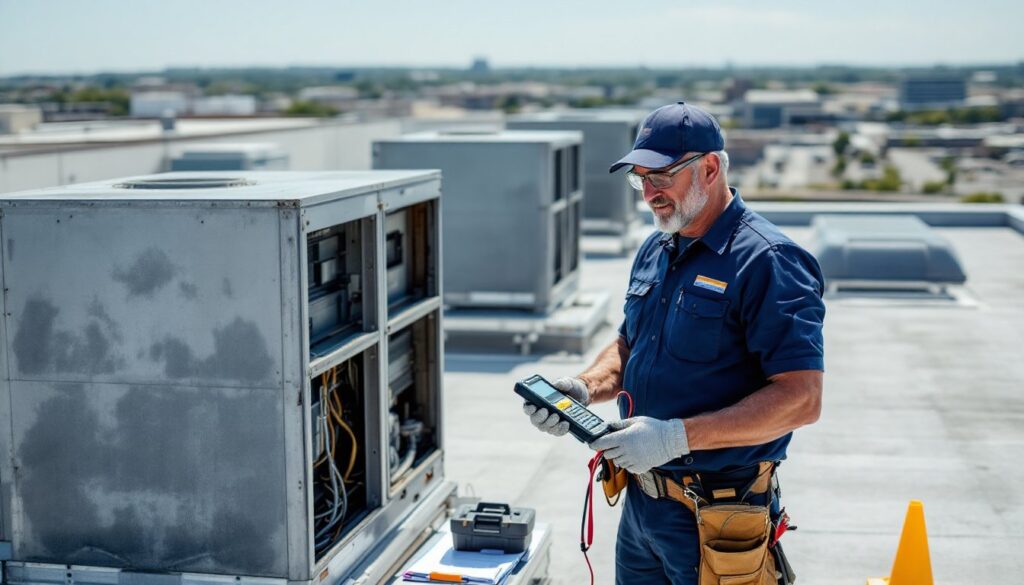
Most agreements schedule visits twice a year, once before cooling season and once before heating season. Techs will inspect compressors, condensers, evaporator coils, blower motors, heat exchangers, and burners. They’ll check refrigerant levels, test capacitors and contactors, measure amperage draw, inspect belts for wear, and lubricate moving parts.
Expect them to clean or replace filters (though high-occupancy buildings may need monthly filter swaps done by in-house staff). They’ll clear condensate drains, check thermostat calibration, and verify that safety controls and limit switches are working. On rooftop units, they’ll inspect dampers, economizers, and outdoor air intakes.
For boilers and hydronic systems, inspections include checking water levels, testing pressure relief valves, inspecting heat exchangers for cracks, and verifying flue draft. On chillers, techs will log refrigerant pressures, check oil levels, inspect starter contacts, and test safeties.
Documentation matters. Each visit should produce a written report listing what was done, what was found, and what needs attention soon. If a tech notes that a compressor is drawing higher amps than spec, you have a heads-up to budget for replacement before it grenades mid-summer.
Priority Service and Emergency Response
Most mid-tier and premium agreements guarantee priority response. If your RTU quits on a 95-degree afternoon, you’re not waiting three days for a callback. Many contracts specify a response window, often within four hours for emergencies, sometimes faster.
Some agreements include after-hours and weekend service at no extra charge. That’s critical for buildings with 24/7 operations or temperature-sensitive inventory. A standard service call on a Sunday might bill out at double-time rates: a maintenance agreement locks in a fixed cost or waives the premium.
Emergency coverage usually doesn’t mean free repairs. If a compressor fails, you still pay for the part and the labor to install it, but you skip the trip charge, get the discounted contract rate, and jump the queue. A handful of premium plans bundle in labor or offer a bank of covered repair hours per year.
Read the fine print on what counts as an emergency. A total system failure in extreme weather qualifies. A noisy fan that’s been acting up for weeks probably doesn’t.
How to Choose the Right Maintenance Agreement for Your Property
Start by inventorying your equipment. List every rooftop unit, split system, chiller, boiler, air handler, and heat pump. Note the age, brand, and whether each unit is still under manufacturer’s warranty. If a unit is covered by warranty, some maintenance tasks might be required to keep that warranty valid, check the fine print.
Match the agreement tier to your equipment’s age and usage. A newer building with three-year-old Carrier RTUs running standard office hours can get by with a basic plan. A 20-year-old building with mixed-brand equipment running 12 hours a day needs a more comprehensive plan, possibly one that includes parts and labor coverage.
Ask what’s not covered. Most agreements exclude structural issues, ductwork replacement, major refrigerant leaks, control system overhauls, and equipment past a certain age (often 15–20 years). If your building has aging equipment, ask about extended coverage or a plan that includes budgeted equipment replacement.
Verify that the contractor is licensed, insured, and familiar with commercial systems. A tech who works on residential split systems all day isn’t equipped to service a 50-ton chiller or a modular rooftop unit with a building automation tie-in. Ask for references from commercial clients with similar equipment.
Check response-time guarantees and geographic coverage. If your building is outside a contractor’s primary service area, you might not get true priority response. Also confirm that the agreement transfers if you sell the property, or if it can be cancelled with reasonable notice if you switch contractors.
Using contractor matching tools can help identify HVAC companies with commercial experience in your area, but don’t rely solely on online listings. Ask for a site visit and a written proposal that itemizes which equipment is covered and what tasks are included.
Cost Considerations and Budgeting for HVAC Maintenance
Pricing varies widely based on equipment type, building size, and plan scope. A basic agreement for a small commercial building with two 5-ton RTUs might run $600–$1,200 per year. A 50,000-square-foot office building with multiple rooftop units, a chiller, and a boiler could see annual costs between $3,000 and $10,000 or more for comprehensive coverage.
Per-ton pricing is common for RTUs and chillers. Expect $75–$150 per ton annually for basic plans, $150–$250 for mid-tier, and $250+ for plans that include parts and labor. A 20-ton rooftop unit on a mid-tier plan might cost $3,000–$5,000 per year to maintain.
Boilers and hydronic systems are often priced separately, sometimes as a flat fee based on BTU input or the number of zones. Add-ons like building automation integration, after-hours service, or coverage for older equipment can bump costs up by 20–40%.
Compare the annual contract cost to your average repair spending. If you’re already spending $5,000 a year on emergency calls and parts, a $4,000 maintenance agreement that cuts failures in half is a net win. Use resources like cost estimators to benchmark typical commercial HVAC expenses in your region, but remember that deferred maintenance always costs more in the long run.
Budget for what’s not covered. Even with a comprehensive plan, you’ll eventually face capital expenses, replacing an aging chiller, upgrading controls, or retrofitting for refrigerant compliance. A well-maintained system lasts longer and gives you more lead time to plan those replacements, but it doesn’t eliminate them.
Finally, ask about payment terms. Monthly billing smooths cash flow better than a lump-sum annual fee. Some contractors offer a small discount for paying up front: others charge a premium for month-to-month flexibility. Read the cancellation terms carefully, some agreements lock you in for a year and auto-renew.