Table of Contents
ToggleSouth Florida’s heat and humidity don’t take days off, and neither should your air conditioning system. In Boynton Beach, where temperatures hover in the 90s for months at a time and humidity levels can make a mild day feel oppressive, a well-maintained AC unit isn’t a luxury, it’s survival equipment. Homeowners who neglect routine maintenance typically face higher energy bills, shortened equipment lifespan, and the risk of a complete system failure during peak summer heat. This guide covers the essential maintenance tasks that keep units running efficiently, what homeowners can tackle themselves, and when it’s time to call in a licensed HVAC technician.
Key Takeaways
- AC maintenance in Boynton Beach is critical due to the area’s subtropical climate, extended cooling seasons, and environmental factors like salt air that accelerate system wear and reduce efficiency.
- Dirty or poorly maintained AC systems consume 5–15% more electricity than properly serviced units, making regular AC maintenance a direct cost-saver on energy bills year-round.
- Homeowners can perform essential DIY maintenance tasks like replacing air filters monthly (every 30–60 days), clearing outdoor condenser debris, and inspecting refrigerant lines, but must call licensed HVAC technicians for refrigerant work, electrical repairs, and ductwork issues.
- Professional annual maintenance service (typically $150–250) should include refrigerant checks, electrical connections, compressor testing, and condensate drain cleaning to extend system lifespan from the standard 15–20 years.
- A seasonal maintenance checklist tailored to Boynton Beach’s year-round heat should include monthly filter checks, quarterly condenser cleaning, spring pre-cooling-season service, and documented maintenance logs to track performance and preserve system reliability.
Why Regular AC Maintenance Matters in Boynton Beach’s Climate
Boynton Beach’s subtropical climate creates a perfect storm for AC systems. Units here run nearly year-round, with cooling season stretching from March through November, far longer than the national average. That extended runtime accelerates wear on compressors, fan motors, and refrigerant lines.
High humidity compounds the problem. Condensate drainage systems work overtime to remove moisture from indoor air, and when drain lines clog (a common issue in humid climates), water backs up and can cause ceiling damage or mold growth. Salt air from the nearby Atlantic also corrodes outdoor condenser coils faster than in inland locations.
Neglected systems lose efficiency at a measurable rate. A dirty evaporator coil reduces heat transfer capacity, forcing the compressor to run longer cycles. When researching HVAC contractors, homeowners often discover that minor issues left unaddressed, like refrigerant leaks or capacitor degradation, led to major repair bills that could’ve been prevented with annual service.
Energy costs tell the story clearly. The Department of Energy estimates that dirty or poorly maintained AC systems consume 5-15% more electricity than properly serviced units. In Boynton Beach, where AC accounts for roughly 40-50% of a home’s summer electric bill, that inefficiency adds up quickly.
Regular maintenance also extends equipment life. Most residential AC systems are rated for 15-20 years, but units in coastal Florida environments often fail earlier due to environmental stress. Annual professional service combined with routine homeowner tasks can push a system toward the upper end of that range.
Essential AC Maintenance Tasks You Can Do Yourself
Homeowners can handle several critical maintenance tasks without special tools or HVAC certification. These DIY steps improve efficiency and help catch small problems before they require emergency service calls.
Filter Replacement and Cleaning
Air filters are the easiest and most impactful maintenance item. Standard 1-inch pleated filters should be replaced every 30-60 days in Boynton Beach homes due to constant system runtime and high pollen counts. Homes with pets, smokers, or allergy sufferers benefit from monthly replacement.
Check the filter’s MERV rating (Minimum Efficiency Reporting Value). MERV 8-11 filters capture most household particles without restricting airflow. MERV 13+ filters offer better filtration but can strain older blower motors not designed for the increased static pressure. Always verify your system’s maximum recommended MERV rating in the owner’s manual.
For washable electrostatic filters, rinse thoroughly with a garden hose every 30 days and allow them to dry completely before reinstalling. A damp filter promotes mold growth inside the air handler.
Locate the filter slot, typically in the return air grille or at the air handler cabinet. Note the airflow direction arrows on the filter frame and install with arrows pointing toward the blower motor. A backwards filter reduces efficiency significantly.
Outdoor Unit Care and Debris Removal
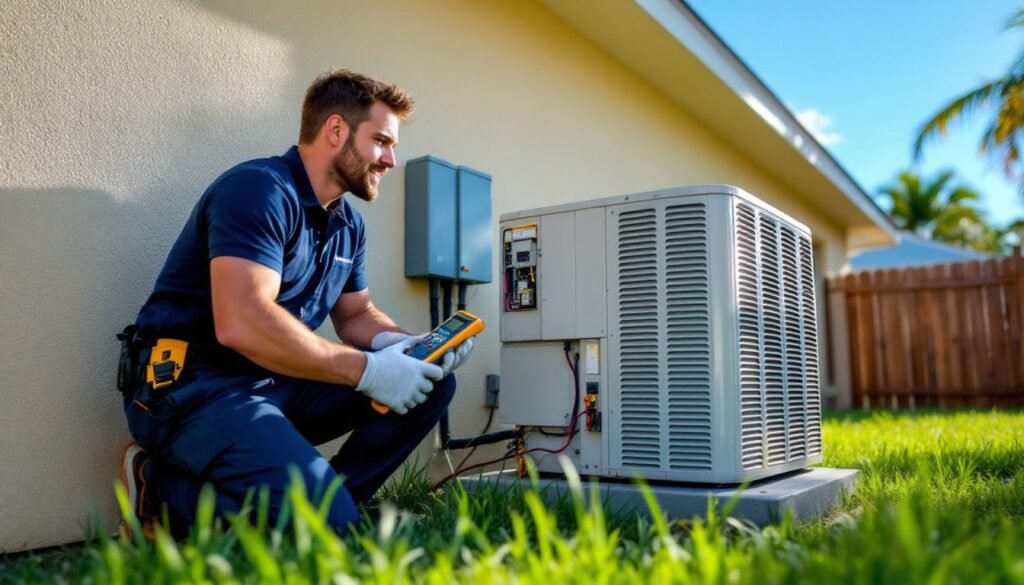
The outdoor condenser unit requires clearance to function properly. Maintain at least 2 feet of clearance on all sides and 5 feet above the unit. Trim back shrubs, remove palm fronds, and clear away grass clippings that accumulate against the cabinet.
Before cleaning, shut off power at the disconnect box mounted near the unit (it looks like a small gray electrical box). Never work on the unit with power connected.
Remove the top grille (usually held by screws or clips) and clear out leaves, seed pods, and debris from inside the cabinet. Use a shop vacuum for small particles.
Clean the condenser coils (the metal fins surrounding the unit) with a gentle spray from a garden hose, working from inside out to push debris away from the fins. Don’t use a pressure washer, it bends the delicate aluminum fins and reduces airflow. If fins are already bent, a fin comb (available at HVAC supply stores for around $8-12) straightens them.
Check the concrete pad beneath the unit. If it’s settled unevenly, the unit may vibrate excessively or strain refrigerant lines. Minor settling (less than 1 inch) is usually acceptable, but significant tilting warrants professional evaluation.
Inspect the refrigerant lines running from the outdoor unit to the house. The larger line should have foam insulation intact. Damaged or missing insulation reduces efficiency and causes condensation dripping. Replacement foam line covers cost $5-15 at home centers and slip on without tools.
When to Call a Professional for AC Service
Some maintenance tasks require EPA-certified technicians, specialized tools, or licensing. Know these boundaries before attempting repairs that could void warranties or violate regulations.
Annual professional service should include refrigerant level checks, electrical connection tightening, compressor amp draw testing, condensate drain cleaning with algaecide tablets, thermostat calibration, and blower motor lubrication (on older units with oil ports). Most HVAC companies in Boynton Beach offer maintenance contracts ranging from $150-250 annually, often including priority service and repair discounts.
Call immediately if you notice ice formation on refrigerant lines or evaporator coils. This indicates either restricted airflow (dirty filter, blocked return vents) or low refrigerant, both require diagnosis. Never chip away ice or continue running the system.
Refrigerant work is strictly professional territory. Federal law requires EPA Section 608 certification to purchase, handle, or add refrigerant. If the system isn’t cooling adequately even though clean filters and coils, suspect a refrigerant leak. Technicians use electronic leak detectors and nitrogen pressure testing to locate leaks before recharging the system.
Electrical issues like breakers that trip repeatedly, burning smells, or capacitors that bulge or leak require a licensed technician. Capacitors store lethal voltage even when power is disconnected. Homeowners comfortable with basic electrical work can visually inspect for obvious issues, but replacement is a professional job.
Strange noises demand attention. Grinding or squealing from the air handler suggests blower motor bearing failure. Loud clanking from the outdoor unit might indicate a failing compressor or loose fan blade, both expensive repairs that worsen quickly if ignored.
Ductwork problems like disconnected sections, crushed flex duct in attics, or significant air leaks at boot connections reduce system efficiency by 20-40%. While homeowners can seal accessible joints with mastic (not duct tape, which fails in attic heat), extensive duct repair or replacement requires HVAC professionals.
When researching costs for these services, platforms like HomeAdvisor and ImproveNet provide localized estimates, though actual pricing varies based on system size, repair complexity, and service company overhead.
Seasonal AC Maintenance Checklist for Boynton Beach Homeowners
Boynton Beach’s climate demands a modified maintenance schedule compared to regions with distinct on/off seasons.
Monthly (Year-Round):
- Check and replace air filters
- Verify thermostat is functioning correctly and set to appropriate temperatures
- Listen for unusual sounds during operation
- Inspect visible ductwork in attics or crawlspaces for disconnections
Quarterly:
- Clean outdoor condenser unit and check clearances
- Inspect refrigerant line insulation
- Test condensate drain by pouring a cup of water into the drain pan and verifying it drains freely
- Clear condensate drain line with a wet/dry vacuum from the outdoor terminus
Spring (Before Peak Cooling Season):
- Schedule professional maintenance service
- Clean return air vents and registers throughout the home
- Verify all supply vents are open and unobstructed by furniture or curtains
- Test system under load by setting thermostat 5 degrees below room temperature and confirming it reaches setpoint
Fall (Before “Winter” Season):
- Repeat professional service if running a bi-annual maintenance plan
- Inspect weatherstripping around doors and windows to reduce cooling load
- Check attic insulation levels (South Florida building code recommends R-30 to R-38 in attics)
Safety PPE for DIY Tasks:
- Work gloves when handling sheet metal components or cleaning coils
- Safety glasses when using compressed air or working beneath units
- Dust mask when changing filters in dusty environments
Document maintenance dates and any observations in a home maintenance log. This record proves valuable when selling the home and helps track system performance trends over time. Note the system’s model and serial numbers (located on the data plate on both indoor and outdoor units) for quick reference when ordering parts or scheduling service.
Conclusion
AC maintenance in Boynton Beach isn’t optional, it’s essential infrastructure care. Homeowners who stay on top of filter changes, outdoor unit cleaning, and annual professional service avoid the misery of mid-summer breakdowns and cut hundreds off yearly energy bills. The divide between DIY tasks and professional work is clear: handle the routine cleaning and inspection work yourself, but bring in licensed techs for anything involving refrigerant, complex electrical components, or performance diagnostics. Keep that maintenance log current, and your system will likely reward you with reliable service well into its second decade.