Table of Contents
ToggleCove dishwashers represent a significant investment in your kitchen, typically running $3,000 to $5,000 depending on the model and installation requirements. These premium appliances deliver exceptional cleaning performance and quiet operation, but they won’t maintain themselves. Unlike builder-grade dishwashers that might limp along with minimal care, Cove units feature precision spray systems, fine mesh filters, and sophisticated electronics that demand regular attention. Skip the maintenance, and you’re looking at expensive service calls or premature failure. This guide walks through the specific tasks that keep a Cove dishwasher performing at factory spec, from daily wipe-downs to monthly deep cleans and troubleshooting common issues before they escalate.
Key Takeaways
- Regular Cove dishwasher maintenance prevents expensive service calls and extends appliance life to 12-15 years of reliable performance.
- Clean the filter assembly monthly and inspect spray arm nozzles for mineral buildup, as clogged components cause 80% of poor wash results and drainage problems.
- Daily gasket wipe-downs and weekly sump area checks take under 30 minutes per month and protect your $3,000-$5,000 investment from premature failure.
- Maintain proper rinse aid levels (setting 3-5) and ensure inlet water reaches 120-150°F for optimal cleaning and to prevent spotting on glassware.
- Keep a maintenance log to document filter cleanings and service records—many Cove warranties require proof of regular upkeep to cover pump and motor failures.
- Call a certified technician for leaks, pump replacement, persistent error codes, or electrical issues rather than attempting DIY repairs that could void your warranty.
Understanding Your Cove Dishwasher’s Maintenance Needs
Cove dishwashers use a multi-stage filtration system and precision-engineered spray arms that differ significantly from standard residential dishwashers. The filtration assembly typically includes a micro-mesh filter (80-100 micron) combined with a coarser pre-filter that traps larger food particles. This dual-layer approach protects the pump and recirculation system, but it clogs faster than single-filter designs if not cleaned regularly.
The spray arm configuration on most Cove models features laser-cut stainless steel nozzles rather than molded plastic holes. These deliver superior coverage and pressure but are prone to mineral buildup in hard water areas. Water hardness above 7 grains per gallon (gpg) accelerates scale formation on nozzles and interior surfaces.
Cove’s control boards and sensors monitor water temperature, cycle timing, and turbidity (water clarity). When filters clog or spray arms underperform, these sensors trigger error codes or extend cycle times. Regular maintenance prevents false errors and keeps wash cycles running at their programmed duration, typically 90 to 150 minutes depending on the selected cycle.
Most Cove warranties require proof of regular maintenance for coverage on pump and motor failures. Keep a simple log noting filter cleanings and any service performed. This documentation can save hundreds of dollars if a warranty claim arises during the first five years of ownership.
Daily and Weekly Cleaning Tasks for Optimal Performance
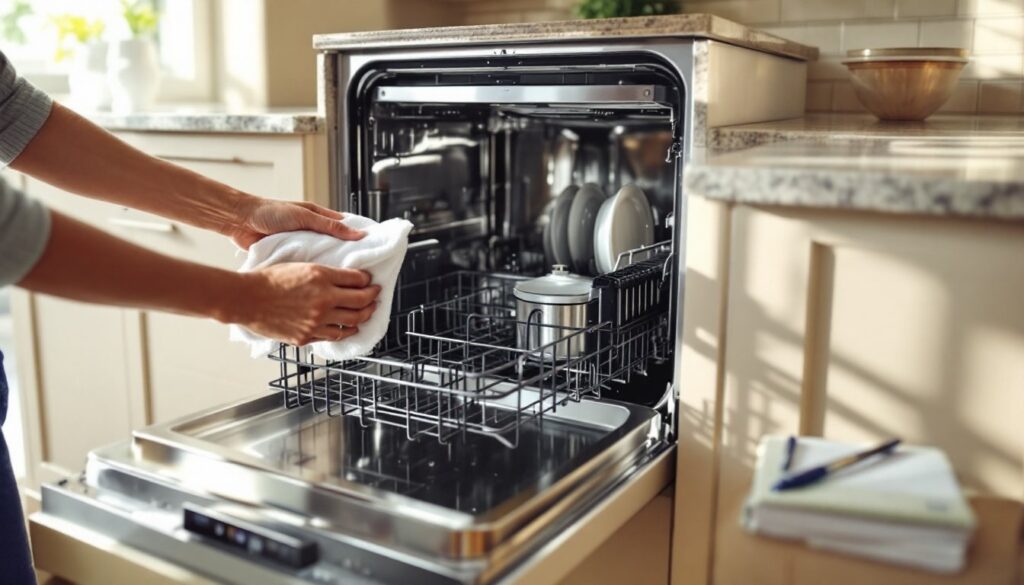
After each wash cycle, wipe down the door gasket with a damp microfiber cloth. Food particles, grease, and detergent residue accumulate in the gasket’s folds, leading to odors and eventual seal degradation. Pay particular attention to the bottom lip where water pools, this is where mold starts.
Leave the door cracked open about 2 inches after the cycle completes. This allows interior moisture to evaporate and prevents musty smells. Cove dishwashers have stainless steel tubs that resist odor better than plastic, but trapped moisture still encourages bacterial growth over time.
Once weekly, remove the bottom dish rack and inspect the sump area (the well at the tub’s base where the filter sits). You shouldn’t see standing water more than 1/4 inch deep. If water remains, the drain pump may be struggling, or the knockout plug in your garbage disposal wasn’t removed during installation, a common oversight that restricts drainage.
Wipe down the interior door panel and controls with a soft cloth dampened with water only. Avoid abrasive cleaners or solvents that can damage the control panel’s touch-sensitive coating. For stainless steel interiors, spray a small amount of white vinegar on a cloth and wipe in the direction of the grain to remove water spots without scratching.
Check the detergent and rinse aid dispensers weekly. Rinse aid reservoirs should stay full, Cove recommends a setting between 3 and 5 (on a 1-6 scale) for most water conditions. Insufficient rinse aid causes spotting and streaking on glassware, and it reduces the effectiveness of the drying cycle. Refill when the indicator light activates, typically every 30-40 wash cycles.
Monthly Deep Cleaning and Filter Maintenance
The filter assembly requires removal and cleaning at least once per month, more often if you run heavy soil loads or don’t pre-rinse dishes. To access it, remove the bottom rack and rotate the cylindrical filter counterclockwise (typically a 1/4 turn). The assembly lifts straight out, it weighs about 8 ounces and consists of two to three nested components depending on your Cove model.
Rinse the filter under running water while brushing with a soft-bristle nylon brush. Don’t use wire brushes or abrasive pads that can damage the micro-mesh. Hold the filter up to a light source: you should see light passing through the mesh evenly. Dark spots or areas that look clogged indicate trapped grease that requires soaking.
For stubborn residue, soak the filter in a solution of 1 cup white vinegar mixed with warm water for 15-20 minutes, then brush again. Some users find that a small amount of dish soap (not dishwasher detergent) helps cut grease, but rinse thoroughly, soap residue can cause excessive sudsing in the next cycle. According to cleaning best practices, regular filter care is the single most effective step for maintaining dishwasher performance.
Reinstall the filter by aligning the tabs and rotating clockwise until it locks. An improperly seated filter allows unfiltered water to recirculate, reducing wash quality and potentially damaging the pump.
Inspecting and Cleaning Spray Arms and Nozzles
Remove both the upper and lower spray arms by unscrewing the central cap or releasing the locking clip, depending on your model. Cove’s upper spray arms typically hang from a water feed tube, while the lower arm sits on a central hub.
Inspect each nozzle hole using a flashlight. Mineral deposits appear as white or tan crusty buildup. Use a straightened paper clip or toothpick to clear clogged nozzles, work gently to avoid enlarging the precision-drilled holes. Flush the spray arm under running water while spinning it to verify all nozzles are clear.
If mineral buildup is heavy, submerge the spray arms in undiluted white vinegar for 30 minutes. For severe scaling, a solution of CLR (Calcium, Lime, Rust remover) works faster, but follow the product’s dilution instructions and rinse thoroughly. Never use CLR on the dishwasher’s interior surfaces, only on removable components.
Spin the spray arms by hand after reinstalling them. They should rotate freely without wobbling or rubbing against the racks. A spray arm that doesn’t spin indicates a clogged center bearing or debris in the mounting hub.
Troubleshooting Common Cove Dishwasher Issues
White film on dishes: This indicates hard water deposits. Increase the rinse aid setting by one increment and verify you’re using a detergent formulated for hard water (look for products containing citric acid or other chelating agents). If your water hardness exceeds 10 gpg, consider installing a whole-house water softener. Many homeowner maintenance guides recommend testing water hardness annually as mineral content can fluctuate.
Dishes still dirty after cycle: Check the spray arms first, 80% of poor wash results trace back to clogged nozzles or a jammed spray arm. Next, verify the water temperature at the start of the cycle. Cove dishwashers require 120-150°F inlet water for proper detergent activation. Run the kitchen faucet until hot water flows before starting the dishwasher, especially if the water heater is far from the kitchen.
Error codes on display: Cove uses alphanumeric codes (like E1, E4, F2) to indicate specific faults. Consult your owner’s manual for code definitions, many are resettable by powering off the unit at the circuit breaker for 2 minutes. Common codes involve water fill issues (kinked supply line, low water pressure) or drain faults (clogged filter, blocked drain hose).
Standing water after cycle: First, clean the filter assembly, this solves 90% of drainage problems. If water still remains, check the drain hose for kinks or loops that prevent gravity drainage. The hose should have a high loop or air gap installation per local plumbing codes to prevent backflow, but the outlet end must drop lower than the dishwasher’s sump.
Unusual noise during wash: A grinding sound suggests a foreign object (typically a toothpick, twist tie, or broken glass) in the pump housing. Stop the cycle, remove the filter, and check the sump cavity. A humming without water circulation points to a jammed or failed pump motor, this requires professional service.
Door won’t latch: Inspect the door strike and latch mechanism for detergent buildup or debris. A misaligned door can result from an unlevel installation. Use a torpedo level across the top edge of the open door: adjust the leveling legs until the unit sits plumb and level.
Professional Service and When to Call an Expert
Always disconnect power at the circuit breaker before attempting any repair beyond basic cleaning and filter maintenance. Cove dishwashers operate on dedicated 15 or 20-amp circuits, and the control board can be damaged by power surges if you’re working on water connections while the unit is energized.
Call a certified Cove service technician for:
- Leak detection and repair. Water pooling under the unit can indicate a failed door seal, cracked tub, or loose connection at the inlet valve or pump. Leaks can damage flooring and cabinetry fast, don’t delay.
- Pump or motor replacement. These components require specialized tools and parts that aren’t sold retail. Attempting DIY replacement typically voids the warranty.
- Control board diagnostics. Error codes that persist after basic troubleshooting often indicate sensor failures or board-level faults. Boards run $300-600 for parts alone, and misdiagnosis is expensive.
- Electrical issues. If the unit won’t power on, trips the breaker, or shows signs of burnt wiring, this is a job for a licensed electrician or factory-trained tech.
Cove dishwashers qualify for extended warranties through many retailers and third-party providers. These typically cover parts and labor beyond the standard manufacturer warranty (usually 1-2 years full coverage, 5 years on major components). Extended warranties make sense for premium appliances where a single service call can exceed the policy cost. Prioritizing routine upkeep can prevent most repairs, similar to the approach outlined in smart home management strategies.
Schedule annual professional maintenance if your water is very hard (above 15 gpg) or if you run more than 10 cycles per week. A tech can descale internal components, recalibrate sensors, and inspect hoses and electrical connections that aren’t accessible during routine homeowner cleaning. Annual service runs $150-250 in most markets but often catches small issues before they become expensive failures.
Conclusion
Cove dishwashers deliver exceptional performance, but only when properly maintained. The tasks outlined here, daily gasket wipes, weekly sump checks, monthly filter cleanings, and periodic spray arm inspections, take less than 30 minutes per month combined. That’s a small investment compared to a $400 service call or premature appliance replacement. Keep your owner’s manual accessible, maintain a simple maintenance log, and address issues when they’re still minor. A well-maintained Cove dishwasher should deliver 12-15 years of reliable service.