Table of Contents
TogglePhoenix homeowners know the drill: when summer temperatures soar past 115°F, a working air conditioner isn’t a luxury, it’s survival equipment. A breakdown in July can mean sweltering nights, emergency service calls with premium pricing, and scrambling for hotel rooms. Regular AC maintenance isn’t just about efficiency or saving a few bucks on electric bills. In the Valley of the Sun, it’s about making sure your system doesn’t fail when you need it most. This guide walks through exactly what Phoenix homeowners should do to keep their cooling systems running reliably through the brutal desert summer.
Key Takeaways
- AC maintenance in Phoenix is critical because systems run 2,000–3,000 hours annually—double the manufacturer rating—due to extreme desert heat and near-constant summer operation.
- Homeowners should perform monthly DIY maintenance tasks including filter replacement (every 30–45 days), condenser coil cleaning, and condensate drain checks to prevent emergency service calls.
- Schedule professional AC maintenance before March–April arrives; waiting until summer means competing with emergency calls, longer wait times, and premium pricing.
- Desert dust and extreme heat cause Phoenix AC components like capacitors to degrade 40–50% faster, with capacitors lasting only 5–7 years instead of 10 years in moderate climates.
- Compressor failure—the most expensive repair at $1,500–3,000—is preventable through regular coil cleaning, capacitor replacement every 5–7 years, and electrical component testing by certified technicians.
- A comprehensive AC tune-up costs $89–150 in Phoenix and should include electrical testing, refrigerant checks, ductwork inspection, and airflow measurement to catch problems before costly failures occur.
Why AC Maintenance Is Critical in Phoenix’s Extreme Climate
Phoenix presents unique challenges that accelerate AC wear beyond what manufacturers design for in moderate climates. The combination of extreme heat, dust storms, and near-constant operation creates a perfect storm for system failure.
Most residential AC units are rated for approximately 1,000-1,500 hours of annual operation. Phoenix systems routinely run 2,000-3,000 hours per year, sometimes more. That’s double the workload, compressed into six months of relentless heat. While a Kansas City homeowner might cycle their AC on and off throughout summer, Phoenix units run continuously from May through September, often 12-16 hours daily.
Desert dust infiltrates everything. Haboobs and everyday wind carry fine particulate that clogs filters in weeks rather than months. This dust coats condenser coils, reducing heat transfer efficiency by 20-30%. When coils can’t expel heat effectively, compressors work harder, run hotter, and fail earlier.
Temperature extremes matter too. Outdoor condenser units sitting in 130°F+ direct sun operate well above their designed ambient temperature range. Capacitors, which help motors start and run, degrade faster in sustained heat. A capacitor rated for 10 years in moderate climates might last 5-7 years in Phoenix. Regular maintenance catches these failures before they cascade into compressor damage, which can cost $1,500-3,000 to replace.
Essential AC Maintenance Tasks for Phoenix Homeowners
DIY Maintenance You Can Handle Yourself
Homeowners can handle several critical tasks without calling a technician. These simple jobs prevent the majority of service calls.
Filter replacement tops the list. In Phoenix, check filters monthly during peak season. Standard 1-inch pleated filters should be replaced every 30-45 days when the system runs constantly. Homes near dirt lots or construction may need bi-weekly changes. Use MERV 8-11 filters, higher ratings restrict airflow in older systems, forcing the blower motor to work harder.
Condenser cleaning requires only a garden hose and 15 minutes. Shut off power at the disconnect box near the outdoor unit (required by NEC for all AC installations). Remove debris, leaves, cottonwood seeds, tumbleweeds, from around the unit. Spray coil fins gently from the inside out using a hose with a spray nozzle. Don’t use a pressure washer: it bends the delicate aluminum fins. Straighten any bent fins with a fin comb (around $8 at hardware stores). This is work that many homeowners considering professional AC coil cleaning can often do themselves first.
Check the condensate drain line monthly. In Phoenix’s dry climate, this line might seem unnecessary, but it prevents overflow during monsoon humidity spikes. Pour a cup of white vinegar down the drain line to prevent algae buildup. If the line clogs, the drain pan overflows, potentially damaging ceilings or triggering the float switch that shuts down the system.
Thermostat accuracy matters more than people think. Place a reliable thermometer near the thermostat. If readings differ by more than 2°F, recalibrate or replace the thermostat. A thermostat reading low by 3°F means your system runs unnecessarily, wasting energy and causing premature wear.
When to Call a Professional Technician
Certain tasks require EPA-certified technicians with specialized tools. Don’t attempt these as DIY projects.
Refrigerant work is both illegal and dangerous without certification. If the system isn’t cooling adequately even though clean coils and filters, it likely needs refrigerant. Low refrigerant indicates a leak, simply adding more without fixing the leak wastes money and harms the environment. Technicians use electronic leak detectors, vacuum pumps, and manifold gauges to properly diagnose and repair refrigerant issues.
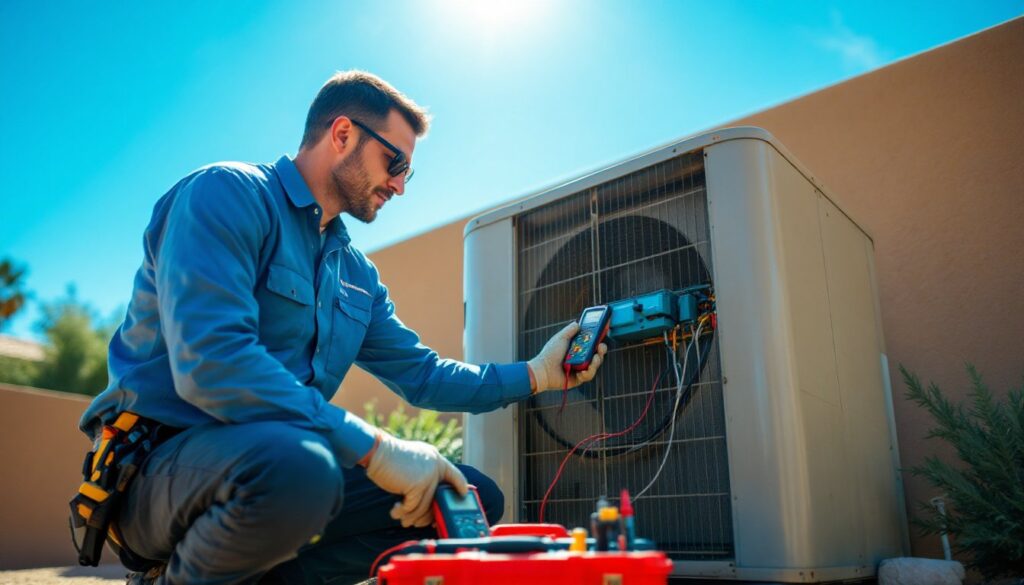
Electrical component testing requires multimeters and knowledge of capacitor ratings, amperage draws, and voltage requirements. Capacitors store electrical charges that can shock even when power is off. Technicians check capacitor microfarad ratings, test contactors for pitting, and measure compressor amp draw to catch problems early.
Ductwork inspection in attics is miserable work in Phoenix, attic temperatures hit 150°F+ in summer. But leaky ducts waste 20-30% of cooled air. Professionals use thermal imaging cameras to identify leaks and measure airflow at registers to ensure balanced distribution. Sealing ducts with mastic sealant (not duct tape, which fails in heat) improves efficiency significantly.
Recommended AC Maintenance Schedule for Phoenix Homes
Phoenix systems need more frequent attention than the standard annual tune-up recommended in moderate climates.
Spring pre-season service (March-April) is non-negotiable. Schedule professional maintenance before temperatures hit triple digits. Technicians can source parts and schedule appointments easily. Wait until June, and you’ll compete with emergency calls, face longer wait times, and possibly pay premium rates.
Monthly homeowner tasks during cooling season (May-October):
- Replace or clean air filters
- Clear debris from condenser unit
- Check condensate drain line
- Verify thermostat accuracy
- Listen for unusual noises (grinding, squealing, banging)
Mid-season check (July) helps catch problems developing under sustained load. Walk outside while the system runs. The condenser fan should spin freely without wobbling. Airflow from the unit should feel strong and hot, if it’s weak, coils may be clogged internally.
Fall follow-up (October-November) after cooling season ends allows assessment of wear. If the system struggled during summer, address repairs before next spring when prices rise and schedules fill. Resources from today’s homeowner guides offer seasonal checklists for tracking maintenance.
Winter monitoring (December-February) still matters. Run the system monthly for 10-15 minutes to keep components lubricated and prevent refrigerant settling issues. Check that nothing has nested in the outdoor unit, birds, rodents, and insects seek shelter in idle equipment.
Common AC Problems in Phoenix and How Maintenance Prevents Them
Compressor failure is the most expensive AC repair, often totaling $1,500-3,000. Compressors fail when forced to operate with dirty coils, low refrigerant, or weak capacitors. Regular coil cleaning and capacitor replacement (every 5-7 years in Phoenix) prevents this cascading failure.
Contactor pitting occurs when electrical contacts arc repeatedly during the thousands of start cycles Phoenix systems endure. Pitted contactors cause hard starting, humming sounds, and eventual failure to start. Annual inspections catch this before the contactor welds shut or breaks apart.
Blower motor failure results from clogged filters forcing the motor to work harder. Restricted airflow also freezes evaporator coils, creating ice buildup that blocks airflow entirely. Replacing filters monthly prevents both problems.
Capacitor failure is the most common Phoenix AC problem. Dual-run capacitors that serve both the compressor and fan motor cost $20-40 in parts but $150-300 installed during an emergency call. Technicians test capacitors during tune-ups using capacitor meters, if readings are 5-10% below rating, replacement is due.
Duct leakage wastes conditioned air in 130°F+ attics. A system struggling to maintain temperature might have adequate capacity but losing 30% of its output to leaks. Duct testing and sealing during maintenance improves comfort without replacing equipment. Estimating repair costs through contractor matching services helps homeowners budget for ductwork improvements.
Drain line clogs cause water damage and system shutdowns. While rare in Phoenix’s dry climate, monsoon season brings humidity that activates condensate production. A clogged line during a humid spell floods the drain pan, triggering the float switch and shutting down the system until cleared.
What to Expect During a Professional AC Tune-Up
A thorough professional tune-up takes 60-90 minutes and covers both indoor and outdoor components. Understanding what technicians should do helps homeowners identify comprehensive service versus quick visual checks.
Outdoor unit inspection starts with electrical testing. Technicians measure voltage at the disconnect, check the contactor for pitting, and test the capacitor with a meter. They measure amp draw on both the compressor and fan motor, readings significantly above the nameplate rating indicate problems. The condenser coil gets inspected for damage, cleaned if needed, and the fan motor is lubricated if it has oil ports (many modern sealed motors don’t require this).
Indoor unit work includes inspecting the evaporator coil for ice, dirt, or biological growth. The blower wheel should be checked for dust buildup, even with regular filter changes, some dust accumulates. A dirty blower wheel creates imbalance, noise, and reduced airflow. Technicians verify the condensate drain flows freely and inspect the drain pan for rust or cracks.
Airflow measurement at supply registers helps identify duct problems or undersized returns. Technicians use anemometers or hood flow meters to verify CFM (cubic feet per minute) matches system specifications. Inadequate airflow causes frozen coils and reduced efficiency.
Refrigerant check involves measuring superheat and subcooling, technical readings that determine if refrigerant charge is correct. Low refrigerant reduces cooling capacity: overcharging damages compressors. Proper charging requires precision, not just topping off until it “feels cold.”
Thermostat calibration and safety control testing round out the service. Technicians verify the thermostat cycles correctly, check that safety switches function (high-pressure cutout, float switch), and ensure the system shuts down properly.
Expect to pay $89-150 for a standard tune-up in the Phoenix area, though prices vary by company and service package. Avoid companies offering $29 “tune-ups”, these are usually sales calls where technicians identify problems but perform minimal actual maintenance. A legitimate tune-up takes time and includes the tasks listed above, not just a visual inspection and filter change.